
Eyes On: Angela Chen, MD
Eyes On is our monthly spotlight feature highlighting faculty and staff across Harvard Ophthalmology
Angela Chen, MD

Instructor in Ophthalmology at Harvard Medical School; Member of the Cornea Service at Mass General Brigham
How does your clinical work shape the questions you bring to your research, or vice versa?
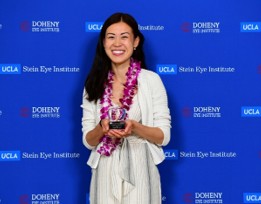
For me, research often starts in the clinical setting, when a patient presents with a question that does not have a straightforward answer. Many of the papers I’ve published began in the clinic with a real person whose unique story required better understanding. I can think of one patient whose presentation did not quite fit the presumed corneal diagnosis. With the patient’s permission, we obtained samples for further analysis, and our subsequent research revealed a different underlying condition that required a different treatment approach. Experiences like this remind me that much of what we encounter in the clinic deserves further investigation.
There is an art to medicine because everyone is different, and each patient teaches us something new. To achieve the best outcomes, we should continually examine the treatment options available to us, their limitations, and strategies to address those limitations. I find that patients are often willing to partner with us in the research process as well; there is a shared desire to move the field forward, not only for their own care but also for future patients and the corneal community as a whole.
Can you tell us about a current or recent project and what excites you most about where it's heading?

I recently worked on a project examining the outcomes of endothelial keratoplasty performed in eyes with prior failed endothelial keratoplasties. The goal was to understand when to pursue another endothelial keratoplasty and what factors may limit the overall success of these repeat procedures. Corneal transplantation is a cornerstone of treatment for many corneal diseases, yet it remains fraught with challenges, including limited access to donor tissue, the risk of graft rejection and failure, and the potential for long-term complications. There is a need to find more sustainable and accessible solutions that do not rely on tissue, as well as more individualized approaches that allow us to match the right intervention to the right person. With so many developments in the pipeline—including advances in cell-based, gene-based, and prosthetic therapies—it is an exciting time to be in the field of cornea.
What's a problem in the field you think is underappreciated or overdue for more attention?
I attended a great session at the Harvard Ophthalmology Biennial Cornea Conference this year highlighting the strides being made to improve access to corneal care, both through advances in diagnostics and through treatments that reduce or eliminate the need for corneal tissue. Given the global shortage of tissue and the burden of corneal blindness, there remains tremendous opportunity to develop and expand non-tissue-based treatments.
I first became interested in this field when I worked in the UCLA Cornea Genetics Lab under the mentorship of Dr. Anthony Aldave, an extraordinary mentor and leader in cornea. There, I gained formative experience conducting genetic and cellular experiments investigating the pathomechanisms by which SLC4A11 deficiency and mutations lead to congenital hereditary endothelial dystrophy (CHED), helping to inform future directions for gene-based therapies.

At Mass Eye and Ear, I have the privilege of working with and learning from Dr. Thomas Dohlman, Director of the Boston Keratoprosthesis Program. Now, with cell-based therapies already underway, we have even more innovative approaches to treating corneal disease.
What does collaboration look like in your work — are there unexpected partnerships or disciplines you've drawn from?
Collaboration is key to improving patient care, not only in clinical practice but also in education and research. My mentors have impressed upon me that teaching is one of the best ways to improve patient care. I enjoy working with trainees, and they constantly prompt me to read, ask questions, and stay informed about evidence-based practices. Beyond individual mentorship, I also value scaling education to reach more learners. I have partnered with colleagues across various ophthalmology subspecialties to publish educational articles and tools, including an interactive topography module for EyeGuru.edu, with the goal of teaching core concepts that can aid ophthalmologists in their clinical practice. In my research, I have worked with colleagues across subspecialties and around the world, gaining a broader understanding of ophthalmic conditions that informs how I approach patient care.
At Mass Eye and Ear, we are fortunate to have a multidisciplinary team made up of leading experts in each field. I routinely communicate and collaborate with the various members of an individual's care team to provide patient-centered, interdisciplinary care.
What are you looking forward to—in your work or beyond—in the coming year?

I had the privilege of training at Mass Eye and Ear as a cornea fellow and am grateful to my wonderful mentors here for their guidance and support. I look forward to working alongside them and caring for our patients, while also contributing to the department that has helped shape my career. I am also excited to connect with and learn from my colleagues and leaders in ophthalmology and other specialties, whether at conferences or through collaborative projects. I aim to continue refining my skills and expanding my knowledge to provide the best possible care for our patients and help advance our field.
What do you enjoy doing outside of your work?
I enjoy spending time with family and friends, exploring different neighborhoods, attending museum exhibits, concerts, and art history lectures, and running along the Charles River. When time permits, I also enjoy traveling abroad and enriching my experiences of different cultures.
It brings me joy to meet new people and become part of each other's journeys, both personally and professionally. I feel thankful for the many people I have had the opportunity to engage with throughout my career—and for those I have yet to meet.